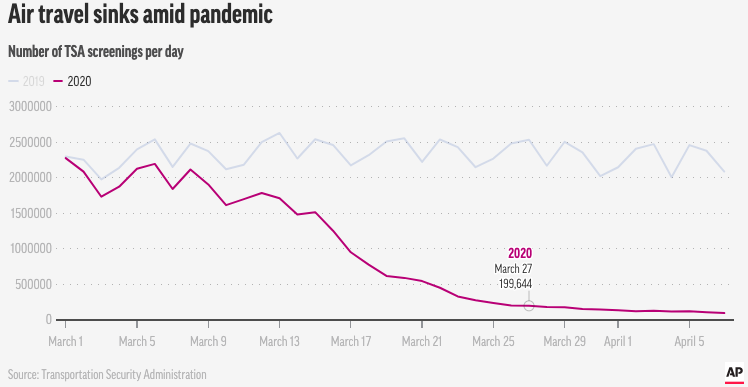
US air travelers have fallen back to 1954 levels.
The Transportation Security Administration screened 94,931 people on Wednesday, April 8, a drop of 96% from a year ago and the second straight day under 100,000.
According to figures from trade group Airlines for America, the nation last averaged fewer than 100,000 passengers a day in 1954, but it was just recently presented to jets, and companies like Boeing were just beginning to run test flights.
Since the COVID-19 outbreak, airlines have drastically cut the number of flights to match demand and save cash, but results are still devastating. According to the Associated Press (AP), United Airlines says it is losing $100 million a day. Delta Air Lines says it is burning through $60 million a day. All the leading U.S. carriers have applied for federal grants to cover payroll costs through September and some are likely to seek federal loans or loan guarantees.
The recovery in air travel — whenever it occurs — could depend on many factors including social-distancing rules and the state of the economy, which is staggering as 16.8 million people — one in every 10 workers — have filed new claims for unemployment benefits in the last four weeks.