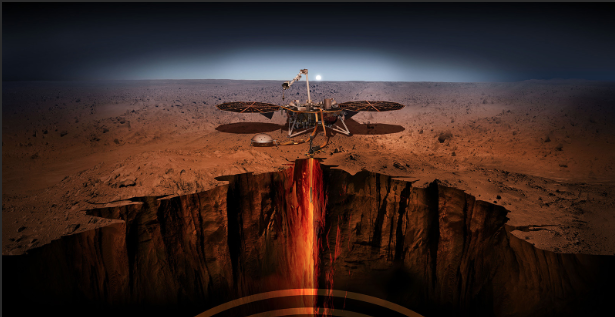
NASA’s first spacecraft built to explore the deep interior of another world, landed Monday on Mars.
InSight is scheduled to land on a vast, barren plain on Mars on Monday after a six-month voyage through deep space.
NASA’s first spacecraft built to explore the deep interior of another world, lands Monday on Mars will be carrying instruments to detect planetary heat and seismic rumblings never measured anywhere but Earth.
According to Reuters, if all goes according to plan, InSight will hurtle through the top of the thin Martian atmosphere at 12,000 miles per hour (19,310 kilometers per hour).
InSight will descend 77 miles with a giant parachute and retro rockets through pink Martian skies to the surface in 6 1/2 minutes, traveling a mere 5 mph (8 kph) by the time it lands.
The stationary probe, launched in May from California, will then pause for 16 minutes for the dust to settle, literally, around its landing site, before disc-shaped solar panels are unfurled like wings to provide power to the spacecraft.
The mission control team at NASA’s Jet Propulsion Laboratory (JPL) near Los Angeles hopes to receive real-time confirmation of the craft’s arrival from data relayed by a pair of miniature satellites that were launched along with InSight and will be flying past Mars.
InSight is expected to yield the first meaningful data on planetary seismic tremors beyond Earth, it is also fitted with a German-made drill to burrow as much as 16 feet (5 meters) underground, pulling behind it a rope-like thermal probe to measure heat flowing from inside the planet.
Then, a radio transmitter will send back signals tracking Mars’ subtle rotational wobble to reveal the size of the planet’s core and possibly whether it remains molten.
Scientists expect to see a dozen to 100 marsquakes during the mission, producing data to help them deduce the depth, density and composition of the planet’s core, the rocky mantle surrounding it, and the outermost layer, the crust.
Officials say it will take two to three months for the main instruments to be deployed and put into operation.
Landing is scheduled for 3 p.m. EST (2000 GMT). Watch the full stream here.